COWBRIDGE FREEDOMS AND THE EBSWORTH CASKET
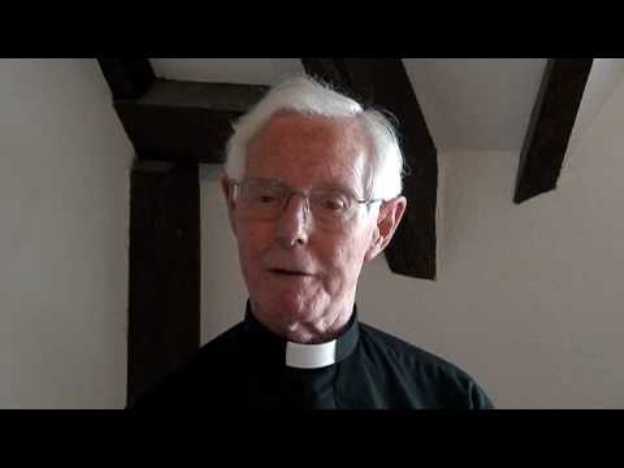
The History group of Cowbridge U3A was entertained in April 2018 by in-house speaker the Reverend Norman Williams, a well-known figure about the town. His talk was entitled ‘Freedoms’, which gave no clues about the subject matter, but this did not prevent a good turn-out of attendees.
Norman revealed that he had been informed at theological college that sermons should last no longer than 12-20 minutes depending on the service being held, but that the audience were now about to receive more than double the recommended homily maximum.
The origins of his presentation dated back to the 1970s, when Cowbridge had been demoted from Borough status by the national local government changes in 1972. An ancient right, dating back to at least 1254 in the reign of Henry III, when the first known charter was granted to the town, had ended. This also meant that Cowbridge was deprived from giving Honorary Freedoms to people of distinction in the future.
Before the 1832 Reform Act, being granted the Freedom of a Borough meant the holder had the right to vote in elections for Members of Parliament. This valuable privilege was only for the few: the ballot count in 1820 for Cowbridge showed only 42 votes had been cast by the Freemen and Burgesses of the town.
Boroughs such as Cowbridge enjoyed autonomy in making appointments such as Coroner, Sheriff, Magistrates and police officers and controlling local markets and fairs, running the local gaol, suppressing nuisances and recovering small debts; for many areas all these appointments and functions were undertaken at county level.
Other, lesser appointments that could be made by the town were clerks of the market and the slaughterhouse, cross keeper, town crier, a bell ringer, an organist, town hall keeper, keeper of the pound (an enclosure for stray animals) and ale taster (possibly a much sought-after position). Some of these functions survived until relatively recently.
The area controlled by Cowbridge stretched from Llanharry and Pendoylan to Llantwit Major and Welsh St Donats, some 20 parishes and hamlets. Records show that in 1787, of the 23 alehouses and 3 gin houses in the area, 14 keepers were found guilty of serving short measures.
To be granted the Freedom of a Borough was therefore a significant honour.
The second part of Norman’s talk was on the specific granting of the Freedom of Cowbridge in 1911 to Edward Henry Ebsworth Esq., of Llandough Castle, a local benefactor, who had given generously to the restoration of the Town Hall, the provision of public baths and the establishment of the Young Men’s Institute and Library. He had also gifted a sports field to the town.
It was decided that a suitable casket should be ordered to hold the Article of Freedom, a task that was delegated to the Town Clerk.
Very detailed specifications were drawn up; the casket was to be oblong, of oak or ebony, with silver mounts, and be of the highest class of workmanship and finish. The casket was to open at the side by means of a small door with hinges and a catch, giving access to a space six inches long, three inches wide and three inches deep (this is where the scroll would be inserted). Miniature representation in silver of the maces of the Borough were to adorn the lid, enamelled pictures of Cowbridge Town Hall, the old Cowbridge Town Hall, the old Southgate Arch and Llandough Castle were to be featured, as were portraits of Mr Ebsworth and the Mayor of Cowbridge. The crests and coats of arms of both Cowbridge and Mr Ebsworth were to be in prominent positions, ‘enamelled in true heraldic colours’.
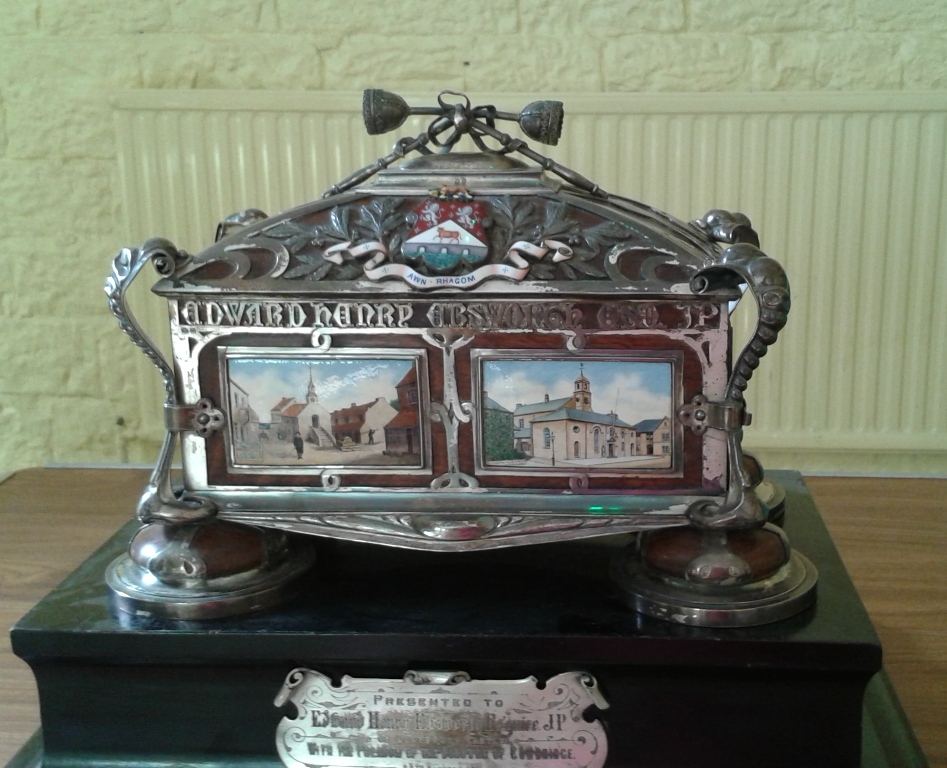
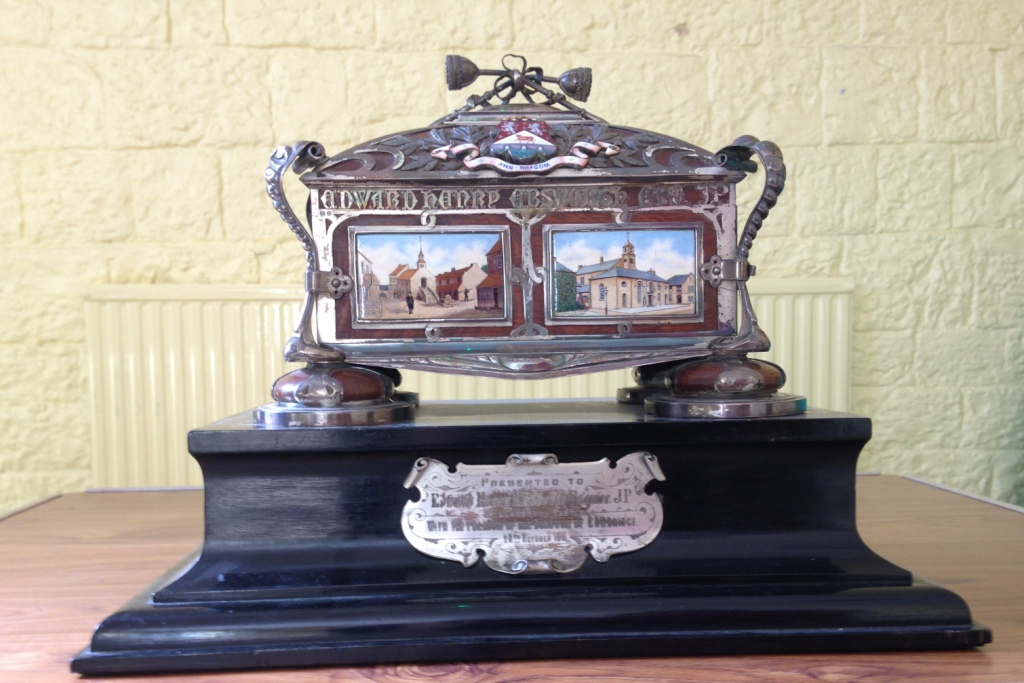
The casket required a plinth, also in oak or ebony, with a silver plate ’engraved in an artistic manner’ with details of the presentation. Finally a lined, red morocco case of good quality to hold everything was to be provided.
The total cost was not to exceed £40.00 (equivalent to perhaps £4,400 today) and the casket delivered by 17 October 1911.
A number of gold and silversmiths, both locally and in London, were contacted by letters sent out on 24 August 1911, with tenders for the work to be received by the Town Clerk on or before 5 September 1911.
The successful bidders were the Alexander Clark Manufacturing Company of Fenchurch Street, London, who successfully resisted an attempt by the Town Clerk to have the price reduced.
The casket was sent by train from London at 1.10pm on 25 October 1911 to Llantrisant Station (Pontyclun), to be transferred to the Cowbridge-bound train. The presentation had been arranged for the following day, so the organisers must have been somewhat nervous, but perhaps they had more faith in transport systems than we do!
The Freedom Ceremony was presided over by the Mayor of Cowbridge, with the Town Clerk, councillors and aldermen in attendance, along with Mr Ebsworth and his daughter, and local VIPs.
Following the award ceremony, the Bear Hotel provided 102 lunches of pigeon pie, roast chicken, ham, sirloin of beef, ox tongue, roast lamb, turkey, various salads, apple tart and cream, fruit salad, claret jelly and Swiss pasties, at 2s/6d per head. Cowbridge Council had sold tickets to this public luncheon for 3s/0d each, exclusive of wine (even invited guests were expected to pay for their meals), so perhaps the profit was used to allay the cost of the casket.
After Mr Ebsworth’s death, the casket was eventually returned to Cowbridge Council by his daughter.
That would have been the end of the story, but, to the great surprise of everyone, including Norman, a local councillor in the audience announced he knew where the casket was now kept: in the Town Hall strong room. The casket was duly fetched and made available for view and photographs, before being returned to safekeeping.
How many people in Cowbridge have even heard of the ‘Ebsworth casket’, never mind seen it?
Steve Monaghan