THE QUINTINSHILL RAIL DISASTER
In 1915, Quintinshill signal box in Scotland was in a remote location (the nearest town was Gretna), sited to control two passing loops, one on each side of the double-track main line of the Caledonian Railway, which ran between Carlisle and Glasgow. It was a busy stretch of line.
Cowbridge U3A History Group learned in July 2019, in an illustrated talk given by stalwart member Gavin Davies, how human error resulted in the worst rail crash in British history, with at least 227 deaths.
The box was staffed by a single signalman, on a shift system. In the mornings, the night-shift signaller would be relieved by the early-shift operator at 6.00am. On Saturday, 22 May 1915, George Meakin was the night signalman, while James Tinsley was to work the early day shift.
On the day of the disaster, the line was to be used between 6.30am and 7.00am by a northbound local stopping train, a non-stop London – Glasgow express, to be followed shortly by a second express and a troop train travelling south, filled with Scottish soldiers, en-route to Gallipoli. An added complication was that both passing loops already contained goods trains.
An informal arrangement between the signalmen meant that the incoming signaller often travelled on the local train, arriving late for his shift. To cover for the delayed changeover, the outgoing signaller would list train movements after 6.00am on a scrap of paper, which the incoming worker could copy into the official log book. The change of handwriting would then tally with the official shift change time. That morning, James Tinsley arrived late on the local train.
Because both loops were occupied, the local train was shunted onto the southbound main line to allow for the Glasgow-bound express to pass through. Although not a preferred method of operation, it was allowed by the rules and was not considered a dangerous manoeuvre, provided the proper precautions were taken. One of these was to put a collar on the relevant signal lever to prevent any southbound movement being allowed. This was not done (experienced signalmen apparently often neglected to do this).
After being relieved by signalman Tinsley, the night duty operative Meakin remained in the signal box reading the newspaper which Tinsley had brought.
The first northbound express train passed through safely. The signal box to the north then indicated the presence of the troop train on its way south, which was immediately accepted by Tinsley. Four minutes later, he was offered and accepted the second northbound express from Gretna Junction (the nearest signal box to the south). Tinsley then received the "train entering section" signal for the troop train and offered it forward to Gretna Junction, having forgotten all about the local passenger train (aboard which he had himself arrived that morning), which was occupying the southbound line. Perhaps he was distracted writing up the log book, but Tinsley pulled the collarless signal lever to allow the troop train to continue forward.
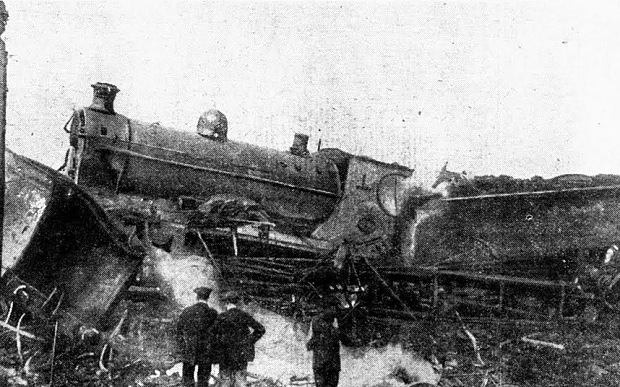
The troop train, travelling at around 70mph, collided head on with the stationary local train already waiting on the line. Just over a minute later, the second northbound express train ploughed into the wreckage, having passed a signal before it could be returned to danger. The wreckage also included the goods train in the north loop and the trucks of an empty coal train in the south loop.
| Quintinshill Rail Crash | a burnt out carriage at Quintinshill |
Many sleeping soldiers, packed like ‘herrings in a barrel’ on the troop train, were killed as a result of the two collisions, but the disaster was made much worse by a subsequent fire. The greater level of wartime traffic and a shortage of carriages meant that the railway companies had to press obsolete rolling stock into service. These carriages had wooden bodies and frames, with very little crash resistance compared with steel-framed carriages, and were gas-lit. The gas was stored in reservoirs slung under the carriages and these ruptured in the collision. Escaping gas was ignited by the coal-burning fires of the engines.
The overwhelming majority of fatalities were among the men of the Royal Scots and the precise number was not established as the roll list of the regiment was destroyed by the fire. The official army report gives an estimated total of 215 deaths and a further 191 injured out of an estimated 500 soldiers aboard the train. Unsubstantiated reports mention officers shooting trapped men who were burning alive.
Twelve civilians were also killed; the total casualty list was 473 dead and injured, making this terrible crash the worst ever in the UK.
The crash investigation laid the blame firmly on the two signallers. They were both charged with manslaughter and found guilty of giving a ‘line clear’ signal on an obstructed track and other breaches of regulations. Tinsley, the more culpable, was sentenced to 3 years imprisonment and Meakin to 18 months. Both served 12 months, after which time they were re-employed by the Caledonian Railway, although not as signalmen. Perhaps the company had been aware of the informal and illegal practices operated by staff, but had taken no action to prevent them.
This was a harrowing story of human fallibility, with terrible consequences, presented in an excellent fashion by the speaker.
Steve Monaghan