THE SINKING OF THE RMS LACONIA; A PERSONAL STORY
It’s not often that an audience remains completely silent, but when the speaker is one of the few females to have spent a night aboard a German U-Boat in the Atlantic in WW11, that’s not surprising.
Mrs Helen Charles (neé Logan), the recent speaker at Cowbridge U3A’s History Group meeting, was delayed by traffic problems, but her presentation on the sinking of the RMS Laconia on 12 September 1942 was certainly worth waiting for.
The Laconia was a Cunard ocean liner, launched in 1921, which was requisitioned by the Admiralty at the outbreak of the Second World War. Initially converted into an armed merchant cruiser, she was refitted in late 1941 as a troopship.
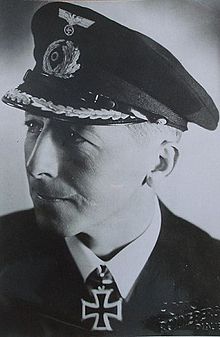
By early 1942 the work was complete, and for the next six months she made voyages to the Middle East. On one trip, the ship was being used to carry some 1800 Italian prisoners of war, along with over 400 Allied service personnel, 80 civilians, plus her crew, so over 2,770 in total. Unescorted and en-route from Cape Town to Freetown, Sierra Leone, and despite following the prescribed zigzag course, on the night of 12 September 1942, the Laconia was struck by two torpedoes fired by the German submarine U-156, commanded by Werner Hartenstein.
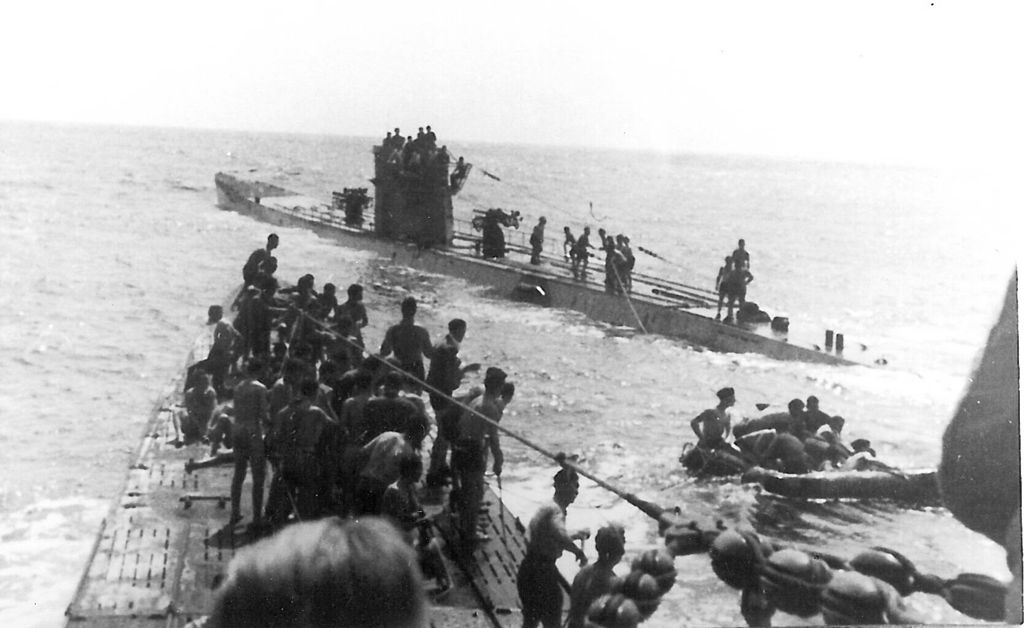
,,Werner Hartenstein of U-156,,U-156 foreground and U-507 background
The ship sank with its captain, Rudolph Sharp, and many of the Italian prisoners still on board. The prospects for those who escaped the ship were only slightly better, as some lifeboats were destroyed in the explosion, so the remaining ones were overcrowded and adrift in mid-Atlantic with little hope of rescue. For those in the water, sharks were common in the area.
Fortunately for the survivors, U-156 surfaced. When Kapitänleutnant Hartenstein realised civilians and prisoners of war had been on board the ship, he asked the U-Boat Command in Germany for assistance. He also signalled by radio to the Allies that a rescue operation was underway. Several U-Boats in the vicinity were dispatched to assist the rescue effort; all would fly Red Cross flags.
U-156 remained on the surface at the scene for the next two and a half days, being joined by U-506, U-507 and an Italian submarine. The survivors were fed and the injured treated. The four submarines, with lifeboats in tow and hundreds of survivors standing on their decks, headed for the African coastline and a rendezvous with several Vichy French warships that had been sent to help the relief mission.
The U-boat's efforts to rescue survivors of its own attack began what came to be known as the Laconia incident.
Sometime later, an American B-24 Liberator bomber appeared in the sky and was signalled to by Hartenstein. Despite the Red Cross flags, the survivors crowded on the submarine’s decks and in the towed lifeboats, the B-24, under orders from its base, started making attack runs on U-156. Hartenstein, to protect his own vessel, had to crash dive, abandoning the survivors. One lifeboat was destroyed in the attack, another overturned.
After the incident, Admiral Karl Dönitz issued the Laconia Order, henceforth ordering his submarine commanders not to rescue survivors after attacks.
Helen Charles was the youngest survivor of the sinking. Her father, from Ynysybwl, was in the RAF and had served in Malta as an ambulance driver. It was here that he had married Helen’s mother in 1940, with their daughter being born in April 1942. When Helen’s father was posted back to the UK later that year, so began a journey from Malta, via Egypt to South Africa, that ended with the family being onboard the RMS Laconia.; Helen was just 5 months old.
Following the drill they had practised, the trio made their way to their lifeboat station after the torpedoes had struck, to find their allocated boat in pieces. Fortunately, they managed to find places in another boat, which was successfully launched despite the increasing list of the ship. There were 80 people in a boat designed to hold 60, with little food and water (but at least Helen’s father had grabbed some nappies as they had left the cabin). Italians were in the water, hanging on to boat’s lifelines; Helen says that these men were shot, to prevent them jeopardising the safety of the overloaded vessel.
After over two days adrift, their lifeboat was spotted by one of other two U-Boats that had arrived on the scene. Helen and her mother were taken into the conning tower and spent a night onboard. The submariner whose bunk they had borrowed ensured that Helen wouldn’t wet his mattress by placing a waterproof coat beneath her.
The artist John Meeks depicted the transfer of the small baby to the submarine in his painting ‘Girl in a Lifeboat’, now in Helen’s possession.
,,,,
Mother and daughter were reunited with the other survivors in the lifeboat and told that rescue ships were on the way. They were fortunate and were soon rescued by the Vichy French cruiser Gloire. Others were not so lucky; only 16 survived out of 69 in one lifeboat and just 4 remained alive in another when rescued after 40 days at sea.
Helen and her parents were interned in Morocco for several months, until freed by the Allied invasion of North Africa.
Mrs Logan, with her baby daughter, travelled to Liverpool by ship and then endured an 11 hour train journey to Cardiff. Here they were met by Helen’s grandfather and two of his brothers, a happy conclusion to a nightmare 3 months. Mr Logan, now back on active service, survived the war.
Just over 1,000 survived the sinking of the Laconia; of these, only 415 were Italians.
None of the three German U-Boat captains involved in the humanitarian rescue effort survived the war, as their submarines were all sunk by attacks by Allied aircraft.
Mrs Charles visits Werner Hartenstein’s birthplace, Plauen in Germany, annually to attend the International Submarine Connection meeting, a memorial society which was formed to promote friendship between former enemies.
Co-incidentally, a dramatised film of the sinking of the Laconia, with screenplay by Alan Bleasedale, was shown on BBC-2 in two parts over the late May Bank Holiday weekend.
Steve Monaghan