COWBRIDGE U3A HEARS STORY OF HANNIBAL (NOT THE CANNIBAL, BUT THE MAN FROM CARTHAGE)
speaker Dr Eve MacDonald Cowbridge U3A History group was visited in September 2019 by Dr Eve MacDonald from Cardiff University, who gave an illustrated presentation entitled ‘Hannibal: a Life and a Legend’.
She was at pains to point out that this was not the Hannibal Lecter of the novels of Thomas Harris (‘Hannibal the Cannibal’), but that the author may have had the Carthaginian in mind when he invented his anti-hero.
Hannibal of Carthage is depicted by the Romans, his sworn enemies, as a brave, brilliant, duplicitous villain of superhuman intelligence, who proved to be a challenging opponent, difficult to subdue.
Dr MacDonald’s view was that ‘the Romans would say that, wouldn’t they?’, as the historian’s main sources of the story of the Punic Wars between Carthage and Rome were written by the victors, the Romans.
A great empire had to have a great enemy and the legacy of Hannibal was that he presented such a challenge that only a mighty kingdom would be able to overpower him. The Roman historian Livy, writing some 100 years later, called his work on the 2nd Punic War ‘an account of the most momentous war ever fought’.
Accordingly, Hannibal’s virtues were bravery and enormous resourcefulness, offset by his vices of being treacherous, having no integrity nor regard for the truth and being pitilessly cruel.
Rome and Carthage had traded peacefully for several hundred years, but increasing friction about influence in the Mediterranean had led to the outbreak of the 1st Punic War. Carthage had lost this conflict and, as a result, its allied territories in Sicily and Sardinia fell under Roman domination.
The Romans then began expanding their influence out of Italy to the north and west into Gaul while the Carthaginians were moving northwards in Spain. Another war between the powers was brewing over the resource wealth of the Iberian Peninsula.
Early in 218BC, the Romans essentially demanded that Carthage give up its Spanish territories. When Carthage declined, Rome declared war. Hannibal, who commanded the Carthaginian army in Spain, knew that the Romans planned a two-pronged attack, with one army being sent towards Spain, while another was poised to invade Carthage. If he stayed in Spain and waited for the Romans to invade, he had no chance of winning.
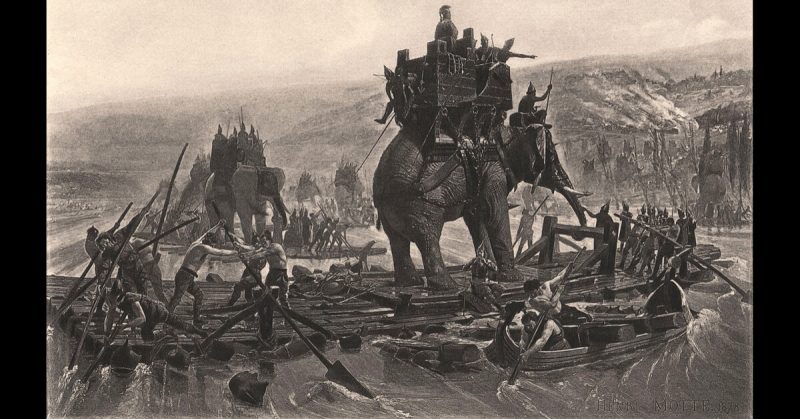
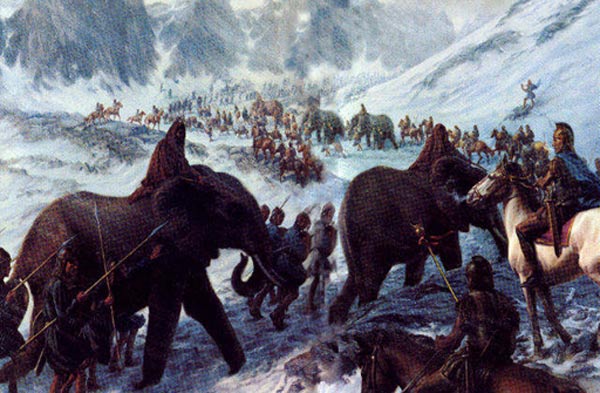
The feat for which Hannibal is most renowned is how he embarked on a long march with his army of infantry, cavalry and elephants (perhaps 40,000 men and 37 pachyderms), crossing over the river Rhône and then the awesome barrier of the Alps to invade Italy. It is claimed that just 26,000 men survived the march, but Hannibal must have judged the losses he suffered along the way to have been worth it.
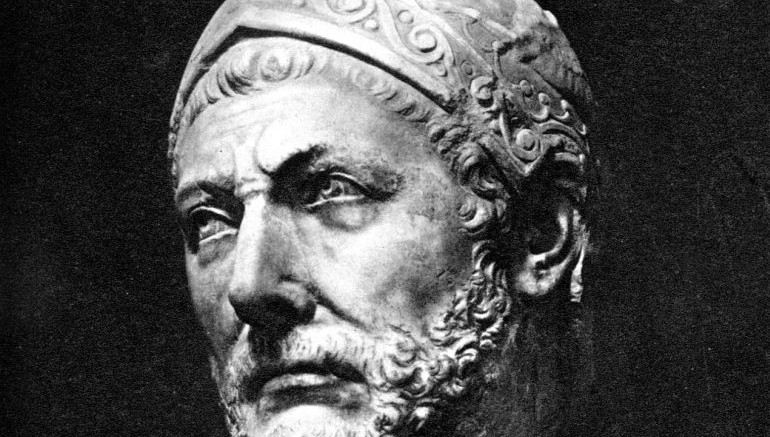
| Hannibal of Carthage | Elephants crossing the Rhone on rafts | The Carthaginian army crossing the Alps |
The route he took across the Alps has recently been mapped by tracking ancient horse dung deposits.
By crossing the Alps with his army, Hannibal had achieved the unachievable, the feat of a daring, supernatural hero and so legends are born.
Over the next few years, Hannibal defeated the Romans in several major battles, including Cannae in 216BC, his most famous victory and a catastrophic defeat for Rome.
Hannibal occupied most of southern Italy for 15 years, but could not win a decisive victory, as the Romans avoided confrontation with him, instead waging a war of attrition. A counter-invasion of North Africa led by Rome forced him to return to Carthage, where Hannibal was finally defeated at the Battle of Zama.
Dr MacDonald, a Canadian, herself learned something from her visit to Cowbridge. She was not aware that Sir Anthony Hopkins, the actor who played Hannibal Lecter, had been a pupil at Cowbridge Grammar School in the 1950s.
Steve Monaghan