THE MEDIEVAL CULT OF ST CHRISTOPHER
Cowbridge U3A History Group had the privilege in April 2019 of hosting Madeleine Gray, Emeritus Professor of Ecclesiastical History at the University of South Wales. Among her areas of expertise are medieval and early modern Welsh history, church history and medieval Welsh tomb carvings; she is one of Wales’s foremost history scholars.
Professor Gray explained that ‘Emeritus’ meant she was no longer paid by the university, but could still use all the departmental facilities – especially the photocopier.
It is disputed whether St Christopher actually existed, but the story is that he was an African martyred by the Romans around 300AD.
The most well-known legend is that he was a giant, who carried travellers or pilgrims over a river. One stormy night he carried a child across the watercourse. The child got heavier, the water higher and the wind stronger on the crossing, such that Christopher was exhausted when he arrived at the other bank. There, the child revealed himself as the infant Christ, bearing all the sins of the world.
In more recent times, St Christopher is known as the patron saint of travellers and images of him are often worn as a medallion around the neck, on a bracelet, or placed in vehicles by Christians.
Professor Gray’s illustrated talk was about the medieval view of St Christopher, when the belief was that devotion to the saint protected the faithful from an ‘evil death’ i.e. one where the believer was excluded from the last rites. These were meant to prepare the dying person for death by providing absolution for sins, so the soul was not excluded from heaven. Life was often short in the medieval world and death was seen as the gateway to the afterlife in Heaven – or Hell.
The wealthy literate could buy books such as the ‘Ars Moriendi ‘(‘The Art of Dying’) which offered advice on the protocols and procedures of a good death.
An adage of the times was ‘On whatever day you look upon the face of St Christopher, on that day shall you surely not die an evil death’, which may explain why many churches held images or statues of him, usually opposite the south door. If the door was open, the people could see the saint without the need to enter and so fulfil the requirement of the instruction.
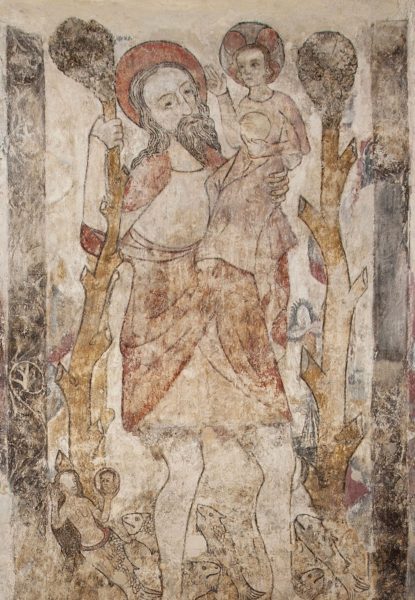
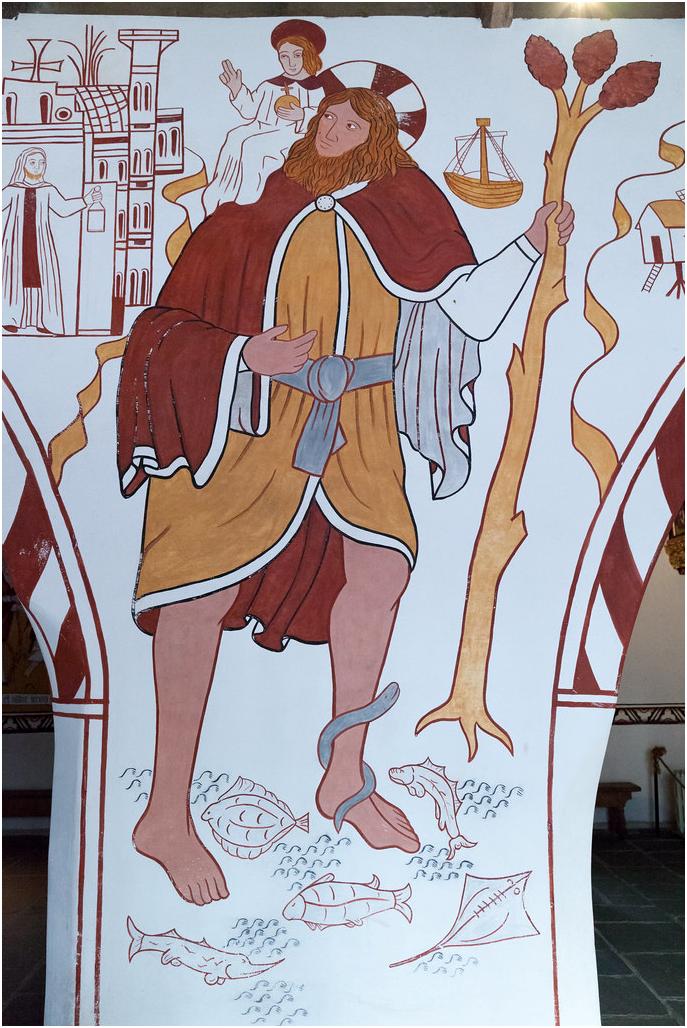
| medieval painting of St Christopher | St Christopher in Church of St Teilo |
St Teilo’s church, originally located in Llandeilo Tal-y-Bont in a bend of the river Lougher, but now reconstructed in the Museum of Welsh Life at St Fagans as it may have appeared in 1530, with all the elements of a late medieval Catholic church, was used as an example.
In a semi-derelict and roofless state, the church was being prepared for dismantling. The ingress of rain had washed much of the lime wash from the walls, revealing fragile paint marks. Careful removal and renovation indicated that there were indeed wall paintings, including one likely to be of St Christopher.
When the church at St Fagans was decorated with brightly-coloured (some may say garish) paintings on the walls, one of the first to be completed was that of St Christopher carrying the Christ child, located directly opposite the main entrance door.
Examples of other churches with wall paintings featuring St Christopher were shown, including Llantwit Major and Llanynys in Denbighshire. The church in Llanblethian had medieval paintings behind the whitewash, but these were removed during Victorian ‘improvements’. It seems that parishes without wealthy benefactors were more likely not to have restoration work undertaken, thus retaining the wall paintings.
To the medieval world, St Christopher was the ultimate assurance of Christ, when needed most, being brought into their lives, especially at the hour of death, when their most challenging journey would be to face the Judgment of God.
A far cry from the modern version of the saint, on whom some rely for protection just for the journey to and from Cardiff!
Steve Monaghan