A LINGERING FEAR – THE STORY OF PONTYPRIDD UNION WORKHOUSE
In August 2019,Cowbridge U3A History group heard the story of Pontypridd Union Workhouse when author Keith Jones gave an illustrated presentation on the building. Saint Dewi Hospital now stands on the site of the much-feared institution where, for the elderly and sick, entry would seem to be a death sentence.
Until 1834, parishes were responsible for the relief of poverty, but, in the 19th Century, as people moved from the countryside to urban areas and the population grew, it was obvious that this system was no longer adequate.
A Royal Commission advocated a universal system of unions of parishes, which could then combine resources to set up workhouses for the poor. The Bridgend and Cowbridge Union comprised 52 parishes, Cardiff Union 44 and the Pontypridd Union of parishes just 6.
The overriding principle was that the conditions in the workhouse were to be worse than the living conditions of the poorest labourer i.e. the places were so uninviting people would try their utmost not to enter the dreaded workhouse. The institutions were likened to prisons for the poor.
It was hoped that the workhouses would reduce the cost of looking after the poor through economy of scale, take beggars off the streets and encourage people to work hard to support themselves and their families. They were to be a safety net of last resort.
Pontypridd Union Workhouse
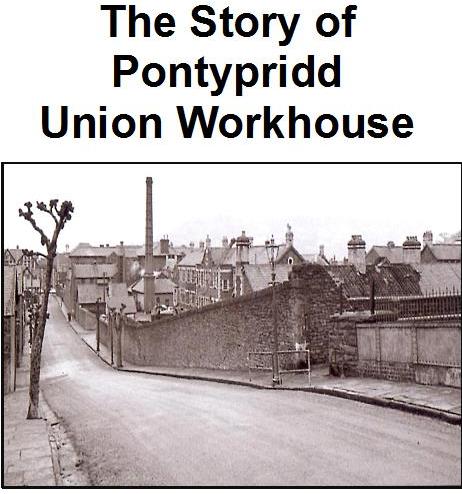
The Pontypridd Workhouse was built in 1865 (the successful tender was £5,990) and was a 3 storey T-shaped building, possessed of a prison-like severity. There are few photographs in existence.
By 1900, the workhouse had greatly expanded with the erection of an infirmary, a children’s section and an isolation hospital. The main building was also enlarged. A directory of 1895 described Pontypridd workhouse as ‘a large and substantial building’ for 314 inmates. Twenty years later, the whole of the site had been built upon and the workhouse could accommodate 500 people, plus up to a further 100 in the infirmary.
Typically, those who entered the workhouse were too poor, too old or too ill to support themselves or were pregnant unmarried women (births in workhouses would number around 7,000 per year). The mentally ill or those with physical handicaps would often be consigned to the mercy of the workhouse. Nationally, up to 6•5% of the population may have been accommodated in workhouses at any given time.
Once inside, men would be separated from women (there was no fraternisation between the sexes), parents from their children, and the aged or infirm from the able-bodied. Workhouse uniforms were issued. Those capable of working were given daily menial tasks such as stone breaking or oakum picking (the teasing out of fibres from old ropes. There was schooling for children and attempts to teach them basic work skills.
Food was kept as tasteless as possible and the same monotonous diet was served on the same weekly menu. A workhouse inmate was only fed about 45% of the amount of food that was served to prison inmates!
As the 20th Century progressed, there was greater emphasis on the medical services provided by the workhouse, such that, at the inception of the National Health Service (NHS) in 1948, Pontypridd Union Workhouse became Graig Hospital. The buildings were demolished in 1965 when a new hospital was constructed on the site.
For many years, the threat of incarceration in the workhouse hovered in the minds of the impoverished, such that, even after the NHS began, there was a lingering fear that going into hospital (often a converted workhouse) was tantamount to the prelude to death.
Steve Monaghan