THE COURT MARTIAL OF SUB LIEUTENANT EDWIN DYETT IN 1916
In July 2018, Cowbridge U3A History Group welcomed one of its members, Gavin Davies, who gave a presentation on the court martial in November 1916 of Sub Lieutenant Edwin Dyett, a member of the Nelson Battalion of the Royal Naval Division (sailors who fought on land as soldiers).
In a departure from the usual method of talks, Gavin presented the audience with the evidence heard at the trial (notes from the hearing were distributed) and then asked them to form small groups to give their verdicts on the case.
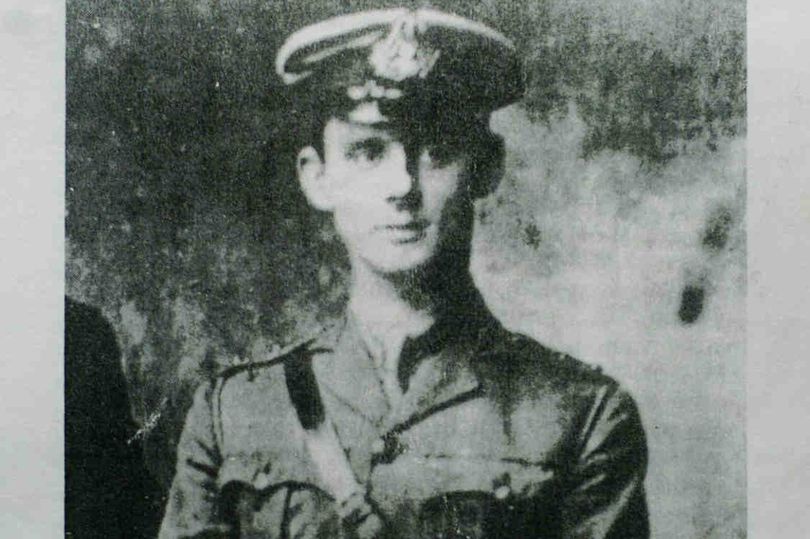
Edwin Dyett was born into a middle class family in Albany Road, Cardiff; his father was a cousin of Sir John French, who was Commander-in-Chief of the British Expeditionary Force (BEF) for the first year and a half of the First World War.
In one of the last major attacks of the Somme battle, the Royal Naval Division were tasked with capturing the villages of Beaucourt and Beaumont Hamel, which had been objectives on the first day of the campaign, almost four and a half months earlier on 1st July 2016.
Dyett and another officer called Truscott were ordered forward to the front line from the battalion reserve to replace officer casualties (19 out of 20 had been killed or wounded). Near Beaucourt station, Dyett and Truscott were ordered by another officer, Herring, to take stragglers back to the front. Although older, Herring was not senior to Dyett (nor for that matter, to Truscott) and the two men argued. It would seem that they already had a poor relationship (Dyett described Herring as ‘my only enemy’) and being given orders from a subordinate was possibly the final straw for Dyett.
| Edwin Dyett | Beaucourt station in recent years |
While Truscott led troops back to the front line, Dyett said he was returning to headquarters (HQ) for further orders.
It was, however, two days later that Dyett arrived at HQ, after wandering around the battlefield, lost, according to his account. Reports have him sheltering in dugouts.
Dyett was charged with desertion on active service (this involves a definite or specific intention to avoid a dangerous duty) and a court martial was ordered. Significantly, no officer in his own battalion was prepared to defend Dyett.
Edwin Dyett had, it seems, a highly neurotic temperament, and had felt for some time that he was not suited to leading troops in the field. He had requested a transfer on four occasions to a shipboard post. As he had never been in action, shellshock was not a reason for his behaviour.
Sub Lieutenant Herring appeared in court and gave evidence that Dyett had not seemed afraid nor gave any indication that he would desert. He also confirmed the story of returning to HQ.
Dyett, who pleaded ‘Not Guilty’, declined to enter the witness box or call any witnesses on his behalf. No medical evidence was submitted.
All the audience panels found Dyett guilty of desertion, but only one advocated the imposition of the death penalty. The majority favoured a dishonourable discharge, followed by imprisonment (some with, some without, hard labour).
What of the actual court martial? The verdict was that of guilty, with a sentence of death by shooting. The panel recommended mercy, on account of Dyett’s youth (he had just turned 21) and his not being a strong character. The divisional commander upheld the plea for clemency, but the corps commander and finally, Field Marshal Haig, ordered the sentence to be carried out.
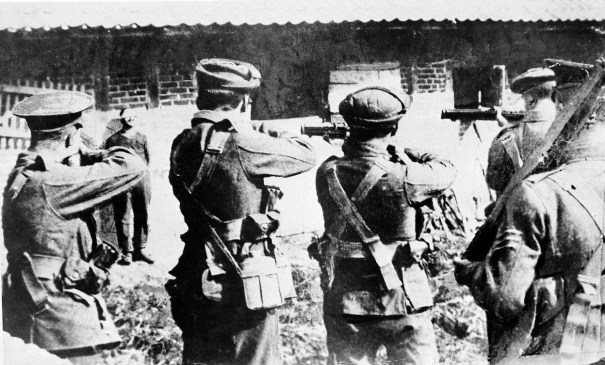
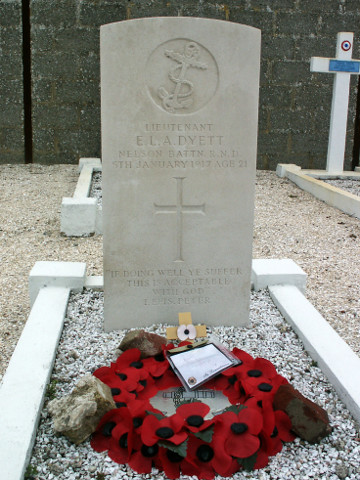
| A firing squad | The grave of Edwin Dyett |
Edwin Dyett was shot by firing squad at 7.45am on 5th January 1917 at St Firmin. His last words, it is reported, were ‘For God’s sake, shoot straight’. He is buried at Le Crotoy communal cemetery.
Steve Monaghan