FROM NEW YORK TO LONDON VIA ABERMAWR: THE TRANSATLANTIC CABLE OF 1866
The talk at the June 2019 Cowbridge U3A History Group meeting was given by Stephen K Jones, an expert on the engineering genius, Isambard Kingdom Brunel, and an author of several books about the great man.
Stephen’s illustrated presentation this time, however, was on the transatlantic cable laid in 1866, on which messages could be sent from New York to London – via the small Pembrokeshire village of Abermawr.
The first attempt to lay a cable between Newfoundland and Ireland was in 1857; this failed when the cable was lost when it snapped, probably because it was not robust enough. The following year, with stronger cable, the line was successfully installed. After the first messages were transmitted in August 1858 between Valentia, Ireland, and Trinity Bay, Newfoundland, 1st September was declared as the official day of celebration in the city of New York.
Unfortunately, the partying was premature, as transmissions only lasted for three weeks before the cable failed; problems with the signals being faint caused the voltage to be increased, which probably burnt out the insulation (which was gutta percha, a tough substance obtained from the latex of Malaysian trees).
The American Civil War delayed the next cable-laying attempt until 1865. This time, rather than using two cable-laying ships, Brunel’s gigantic Great Eastern was used. This vessel, the largest in the world, was converted into a cable layer by the removal of a funnel and the installation of three huge drums on deck. She was able to carry all the cable required. Again, the cable was lost, some two miles below the surface, despite attempts to retrieve it with grappling hooks. This trip proved, however, that the improved methods of making and laying the cable were sound.
A further attempt was made in 1866, again using the Great Eastern, sailing from Ireland. Two weeks later, the cable was landed in Newfoundland and began operating. Some 1600 miles of cable had been laid under the ocean.
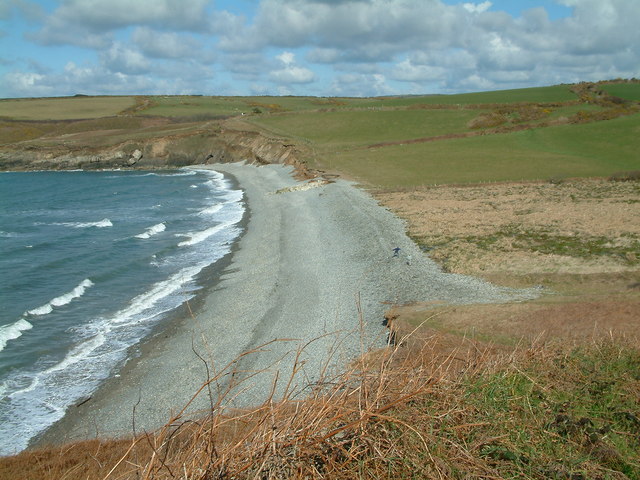
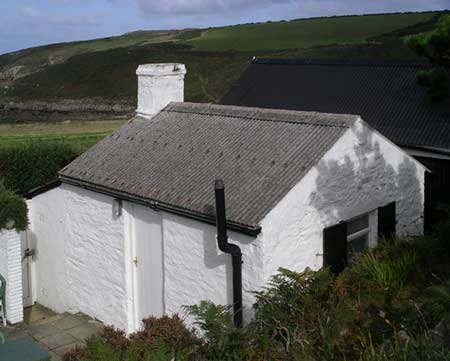
| The Great Eastern laying cable | Abermawr beach | The former telegraph cottage at Abermawr |
The ship then returned to the spot where the 1865 cable had been lost, retrieved it from the ocean bottom, spliced it, and paid out the remaining 600 miles back to Newfoundland. By 8 September 1866, not one, but two telegraph lines were sending messages across the Atlantic. At the time, the transatlantic cable was hailed as the Eighth Wonder of the World.
The UK terminal was Abermawr, which had been earmarked by Brunel as the site where his South Wales Railway would end and passengers could board ships for Ireland and the USA. Perhaps fortunately for Abermawr, when the Great Western Railway took over the project, Neyland became their choice of rail terminus and port.
The original stone telegraph hut and a later corrugated iron one at Abermawr still exist and can be rented as holiday cottages.
In 1865, news of President Lincoln’s assassination took 12 days by ship to reach the UK; by contrast, the death of President James Garfield, shot in 1881, was known about in Britain within hours, thanks to the transatlantic telegraphic route.
In 1922, a great storm washed away the shore ends of the cable at Abermawr and the telegraph station closed; by this time 25 telegraph cables had been laid, so it wasn’t a disaster.
What of the Great Eastern? She finished her life on the Mersey as floating advertising hoarding for the department store Lewis's. She was broken up for scrap at Rock Ferry on the Wirral in 1889/90.
Stephen Jones brought along some interesting exhibits in a display case: a section of both the 1865 and 1866 cables and a part of the iron hawser used, with grappling irons, to drag for the lost 1865 cable.
Steve Monaghan