CARDIFF PARKS IN WORLD WAR I
Rosie James, the Strategy and Development Manager for the Cardiff Parks Service, is well known in South Wales for her range of talks on the history of Cardiff’s parks, so Cowbridge U3A’s History Group were awaiting her May 2017 visit with anticipation. Her subject on this occasion was the story of Cardiff Parks in World War I.
In 1914, there were 20 parks and open spaces in the capital, most owned by the local authority, but some by the Marquess of Bute, where public access was permitted.
On the outbreak of war, it was noted in the Minutes of the Parks’ Committee that a concert by a military band had been cancelled. It was believed that the war would cause a shortage of employment, so plans were prepared to create jobs in the parks for men temporarily displaced from their normal work - these were to be soon shelved as the conflict instead caused a scarcity of manpower.
The Lancashire Fusiliers’ application to use Llandaff Fields for military drills was granted, with the proviso that practice trenches were not to be dug – that would ruin the pitches!
Soldiers were allowed to bathe in Roath Park Lake without charge and members of the armed forces were given free admission to some concerts in the parks (although the popular weekend events were not included, as they were a good money raiser for the local authority). The YMCA erected tents in Victoria and Roath Parks where free refreshments were given to wounded soldiers (easily identified by their blue uniforms).
By 1916, most of the younger parks’ staff were serving in the forces, creating a shortage of labour (the exact opposite of the 1914 opinion). Jobs were often being done by old men, some of whom were just not capable of the tasks asked of them. Women, however, were never employed by the parks’ administrators, despite being used elsewhere in many rôles previously restricted to men.
Within the parks, many of the usual activities had been greatly reduced or had even ceased completely, as, for example, young men were no longer there to be involved in team sports. Bathing receipts at Roath Park Lake were down by a third. The loss of skilled labour and income resulted in services, such as grass cutting and maintenance work, being drastically reduced.
The war also created another shortage: food for the animals kept in the menagerie in Victoria Park, especially for Billy the seal. A Cardiff trawler company was initially supplying fish free of charge, but as the war progressed was unable to continue this arrangement. In 1917, the cost of feeding Billy was reported as £1-14s (£1.70p) each week. The Parks’ Committee discussed whether the seal should be returned to the sea or even be put down, but eventually it decided that Billy should remain, but be placed on half rations. Fortunately, the local populace supplemented the food supply of all the animals and ensured their survival.
Large areas of the parks were allocated to food production and there were thriving allotments in Llandaff Fields (36 acres under cultivation) and Splott, Victoria and Roath Parks. Vegetables, such as beet and carrot, were planted instead of flowers in formal displays in most parks. Many of the allotments continued into the 1920s and some still exist today. Grassed areas were used to produce hay.
When the Summertime Act of 1916 introduced daylight saving, the population of Cardiff found that the parks were available for recreational use after the working day and there were increased receipts from swimming, boating and refreshment sales.
After the Armistice in 1918, all the 35 men from the Cardiff Parks’ Department who had served in HM Forces returned safely; all were offered their jobs back – only one took alternative employment.
There was much work to be done; there were few displays of flowers, paths had deteriorated, wooden bridges had not been maintained and were falling into disrepair, fencing was dilapidated, building work had not been undertaken and Roath Park lake had silted up (it still does!).
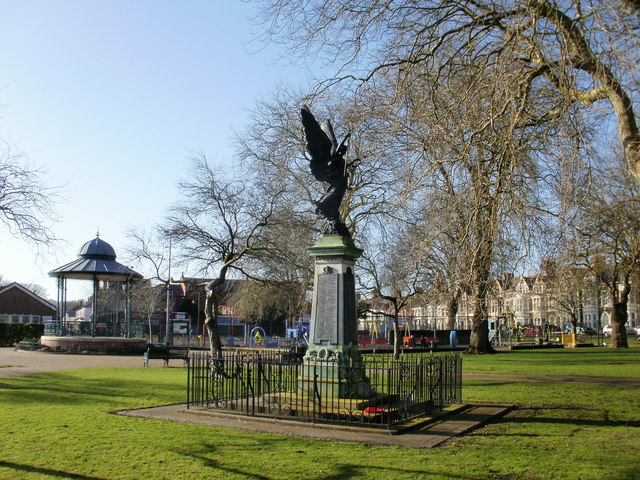
| Winged Angel memorial in Grange Gardens |
Some Cardiff parks have now become the home of memorials to the fallen. The first WWI commemoration in Cardiff was the winged angel in Grange Gardens and the Welsh National War Memorial, unveiled in 1928, is situated in Cathays Park.
Even Billy the seal has been remembered, as a sculpture of her (after Billy’s death in 1939, ‘he’ was found to be a ‘she’) was placed in Victoria Park in 1997.
Steve Monaghan