THE 1918 SPANISH FLU PANDEMIC
As most of you know the history of the First World War is one of my main interests. This, naturally, has led me to look at the 1918 ‘Spanish Flu’ pandemic. I actually wrote the little article below for Gilwern U3A who had to cancel a booking for me to give them a talk next month (June 2020), but I thought it might be of interest to our own U3A members.
In the war the British had huge base camps in Northern France where large flocks of chickens and herd of pigs were kept to provide food for the thousands of soldiers who passed through on their way to and from the front lines. Probably, the Spanish Flu virus started in the chickens, jumped to the pigs and then to humans, getting more virulent and deadly as it moved from species to species. One classic symptom was that the patient’s lips turned blue and the face unusually pale as the virus removed the oxygen from his blood and British soldiers were dying with these symptoms in early 1917.
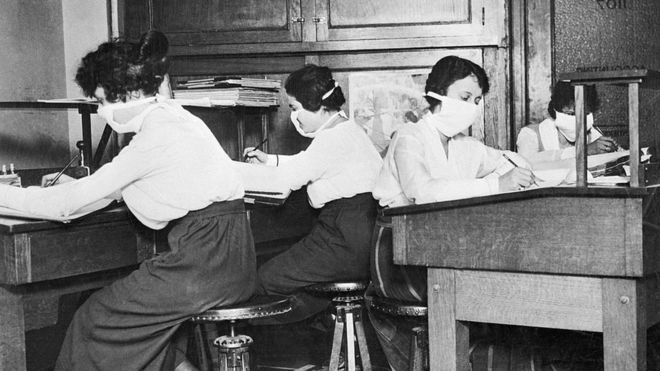
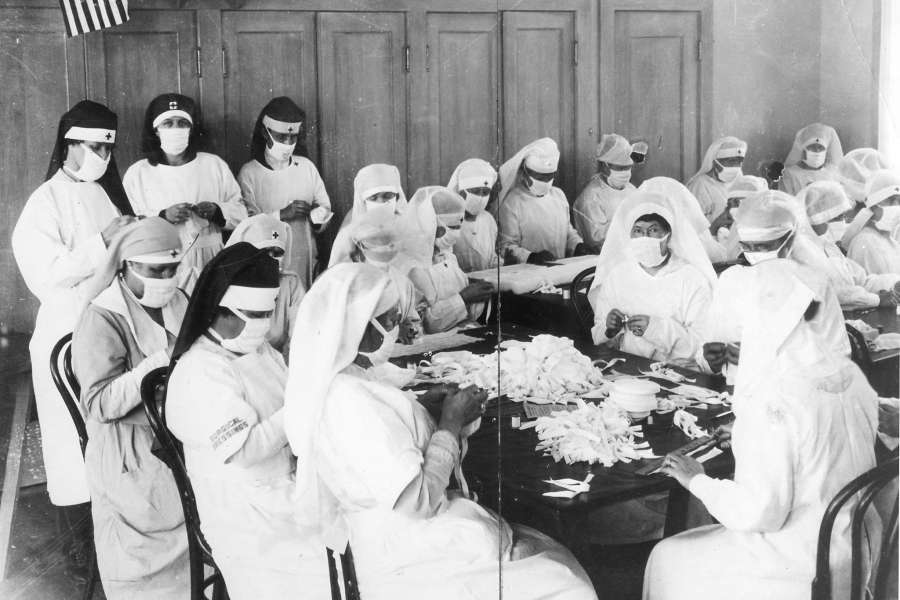
| US Red Cross workers making face masks | office workers |
Remember that in war there are large movements of people in close proximity on ships and trains and that civilians were gathering in large numbers for patriotic rallies. Remember also that although doctors had known about influenza since at least Roman times it was not known that it was caused by a virus because viruses could not be identified. The general assumption was that the disease was only a rather nasty form of seasonal influenza and cases were not isolated so the virus spread rapidly round the world, infecting people everywhere. It is said to have killed over 50 million people worldwide – far more than both world wars.
So, what was a disease that affected Britain, Germany, France, the USA, Italy and many other countries called Spanish Flu? Quite simply, because Spain was neutral. None of the countries at war wanted the enemy to know that their armies were affected so there were security clampdowns but, as Spain was neutral, Spanish deaths were reported in the papers.
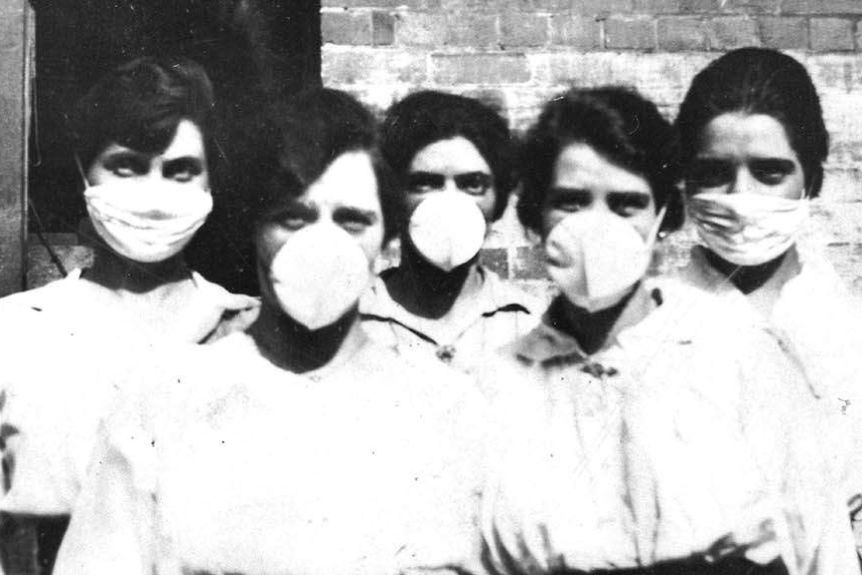
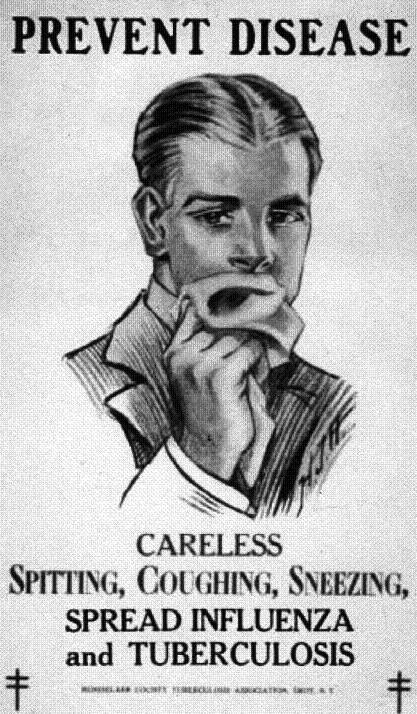
| Face masks, but no social distancing | Spanish Flu advisory poster |
So, while Covid-19 is not, thankfully, as lethal as Spanish flu it can still kill so, perhaps, thinking back to 1918, we should not complain too much about the current lock-down.
Gavin Davies