THE DROVERS' WAY (or pigs in knitted socks!)
Click on coloured text to open Link
It has been estimated that by the end of the 18th. century about 100,000 cattle and 750,000 sheep, together with turkeys, geese and pigs, arrived at London's Smithfield Market each year thanks to the drovers.
Many cross county routes were established to move the animals and it is possible to trace some routes through place names.
For example:
• Bullock, Cow or Ox Lane
• Welshman's Road
• Drift Road (drift is an old word for drove)
• Halfpenny Green (often close to inns where there was a place for animals to
rest over night at the cost of a halfpenny)
• Little London - there are over 100 hamlets & villages with a road of this
name
• Haverfordwest: the ford used by heifers
• Cae Bach Pedoli: the Welsh name for a shoeing field where animals were shod
before the long journey to market.
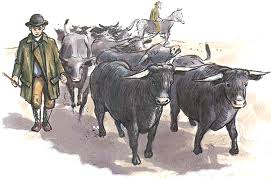
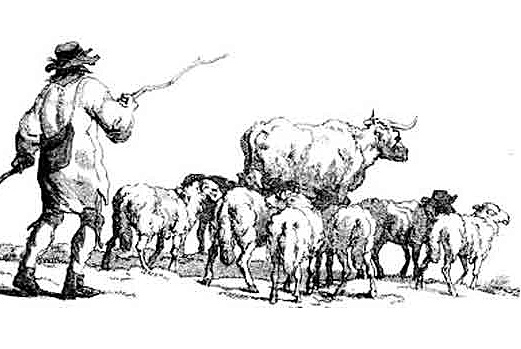
| A cattle drive 1 | A cattle drive 2 |
The main drovers' roads were often wider than normal roads of that time to accommodate large flocks and herds. The verges were also unusually wide and provided some forage for the animals.
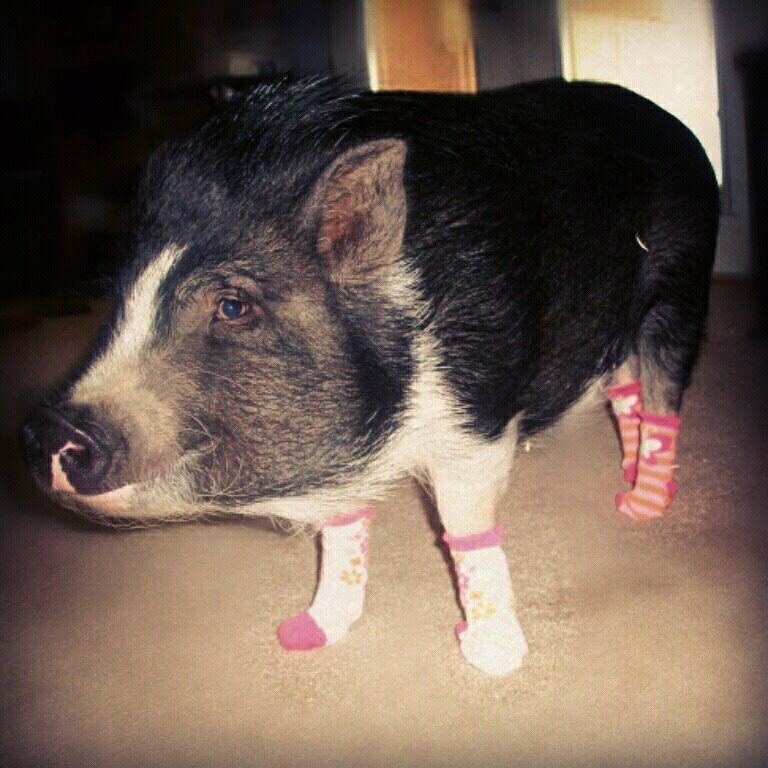
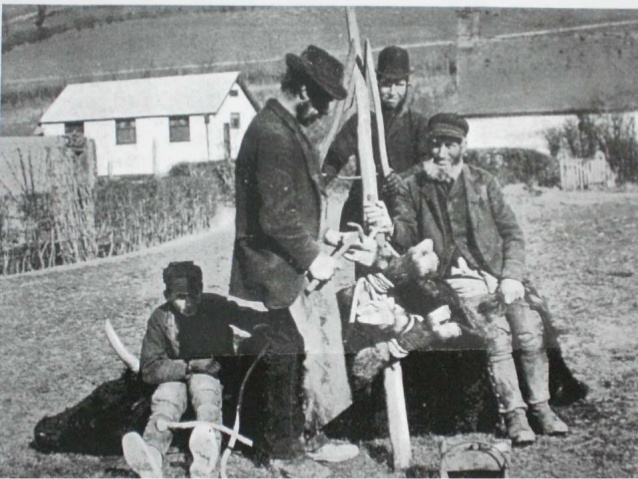
Farmers were instructed to bring their beasts to the starting point by a certain date and time. On arrival, the animals would be shod ready for the metalled roads to market. Cows were fitted with moon-shaped iron shoes, geese were given leather boots, turkeys had their feet tarred and pigs wore knitted socks with leather soles!
| A pig in socks | Cattle shoes | An example of cattle shoes |
The shoeing of cattle
The delay whilst this was done gave the animals time to sort out their hierarchy for the journey ahead. When they set off, the dominant animals would lead and the rest follow behind. An agent would organise the drove, deliver the stock to market and return with the proceeds.
Local farmers were given plenty of warning that the drovers were coming. As well as the usual noise of the animals, the drovers would call and shout loudly as they approached a farm or grazing stock. This was to warn the owners to get their stock safely out of the way, as, if they were caught up in the drovers procession, it would be almost impossible to get them out again.
Animals were not allowed to be moved on Sundays, so drovers would often set off with the stock shortly after midnight on Sunday nights.
The drovers used traditional routes with organised sites en-route for overnight stops providing shelter and food for both animals and drovers. Agreement was made for payment for any stock lost or for animals born on the journey (new-born calves would sometimes be placed in a sack and slung over the mother's back).
Only the foreman would be on horseback, accompanied by up to a dozen men on foot, according to the size of the herd. Dogs would also be used to control the animals.
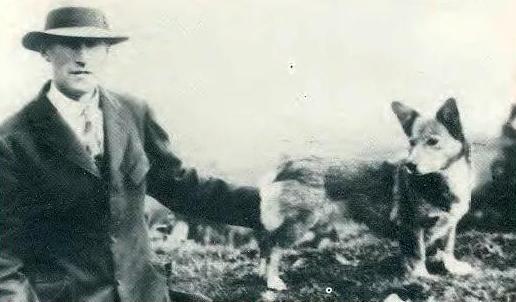
The dogs would attack the heels of an errant beast; even a fierce bull was brought under control by a dog. In England, the favoured dog was a similar breed to the classic sheep dog. In Wales, the Welsh corgi was preferred.Pembrokeshire Corgi Being so small, a corgi could easily get out of the way of an annoyed, kicking beast. Dogs were sometimes sent back home alone once the drive had reached its destination. The dog would follow the same route home and often "lodged" in the same inns as on the outward journey.
From the mid-16th Century, drovers had to be approved and licensed by the District Court and Quarter Sessions. They had to prove they were of good character, married, and householders over the age of 30. Licences were issued annually and lasted three years. Some drovers were actually quite wealthy.
Description of Mr Bos - a drover:
The author met him at an inn on Anglesey. “He was a man seemingly of about 40 years of age with a broad red face, with certain “somethings”, looking like incipient carbuncles, here and there upon it. His eyes were grey and looked rather as if they squinted; his mouth was very wide and when it was open displayed a set of strong white uneven teeth. He was dressed in a pepper and salt coat of the Newmarket cut, breeches of corduroy and brown top boots, and had on his head a broad black coarse low-crowned hat. In his left hand he held a heavy whale bone whip with a brass head.”
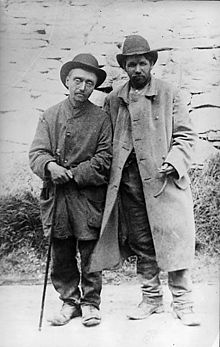
| Drovers in Montgomery | Welsh drovers shoeing a bovine | Cattle and Sheep Drover |
Drovers also acted as messengers, bearers of news and even carried money and important documents for people.
It normally took 3 to 4 days for a drove to settle down to a steady 2 miles per hour, 15 to 20 miles a day. Time was allowed for grazing along the way. The drovers planned their journeys with great care so as to keep the animals in good condition. A journey from Tregaron to Warwickshire was recorded as taking 16 to 17 days to complete.
The dealer or head drover could return home by coach. The hired men walked back. The dealer dressed in an “inconspicuous fashion” so as not to draw attention to himself, as he would be carrying several thousand pounds in gold sovereigns in the long leather pockets of his great coat.
Drovers' routes in Wales often started in deeply set tracks into the countryside between fields with high earth walls and hedges. There is a drovers’ track on the outskirts of Radyr (Cardiff) like this. The most characteristic feature of Welsh tracks is the occasional dog-leg turn, which provided shelter for men and animals in severe rain or snow. A dog-leg can be seen on the Radyr track.
Some drover's tracks followed ancient Roman roads (the Radyr track does this). It is believed that some tracks even date back to before Roman times.
There are records showing substantial trade in cattle from Wales to England during the medieval period, to which cattle from Ireland were sometimes also added, all to feed the growing population of the London area. There were 30 market towns in West Wales from where droves started out. The most used towns were Newcastle Emlyn, Haverford West, Machynlleth and Cilgaran. One report stated that on the 10th of August 1804, 20,000 cattle were assembled in Cilgaran for their journey to England.
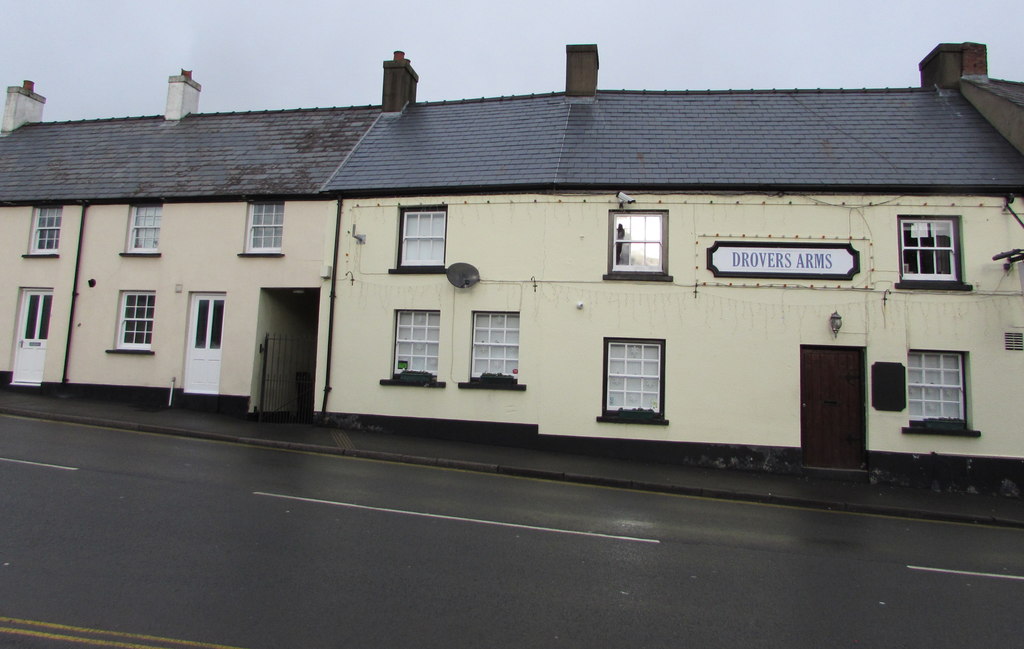
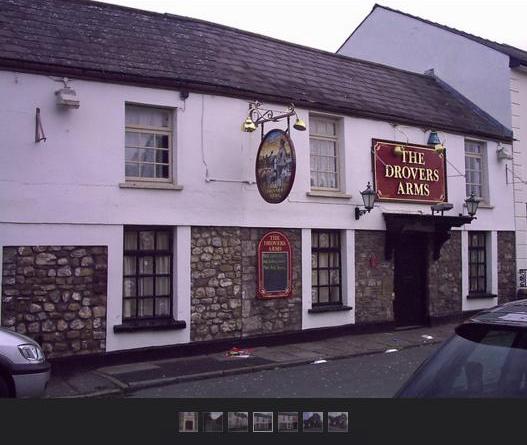
| The Drovers Arms in Caerleon | The Drovers Arms in Brecon |
Many Welsh towns became prosperous thanks to droving. It helped to provide income not only for the farmers but also blacksmiths, merchants, inns and farmhouses, which sometimes doubled as inns. Some towns were designated animal shoeing stations.
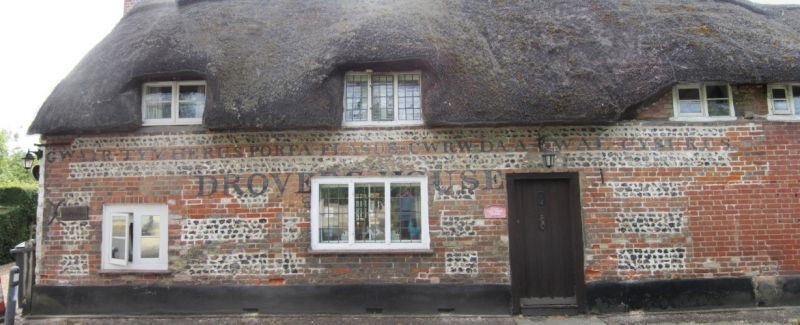
The Drovers house in Stockbridge Hants In Stockbridge, Hampshire, there is a house (once an inn) where an inscription on the wall can still be seen. Written in Welsh (although perhaps not completely grammatical by modern standards) it says:
“GWAYR TYM HERUS PORFA FLASUS” - worthwhile grass and pleasant pasture
“CWRW DA A GWAL CYSURUS” - good beer and comfortable shelter
The last recorded large scale cattle drive from Wales was in 1870 and for sheep in 1900. The majority of Welsh cattle were sold in the Midlands, but some went to London, Surrey, Sussex and Kent. There is a record of a weekly cattle market founded midway between North Wales and London at Newent, Gloucestershire, in 1253.
Railways brought an end to most droving around the middle of the 19th Century.
How did drovers find the stopping places along the routes?
The line of the route was often marked by evergreen trees regularly placed; usually Scots pine, laurel or holly. In Hampshire, they used yew trees. A clump of 3 or 5 evergreens together would mark a crossroads, waterhole, a field for grazing or an inn where drovers could stop for the night. In hilly areas such as Wales, the trees could be seen on the skyline and indicated the direction to follow.
Drovers were paid about 2 shillings a day in the 19th Century, plus a lump sum to cover their needs on the return journey to Wales. The peak moving and selling times were spring and autumn.
There are many records of Welsh drovers from the 17th Century onwards in farm accounts and probate inventories. For example:
In 1776, an Essex farmer recorded purchasing Welsh runts from John Evans at Epping Fair.
Barnet Fair had a centuries-old tradition of being a gathering place for Welsh drovers.
Here is the account of a drover for October 1839:
Boy drive the beast 2/-
Llandrindod grass 13/ 6d.
Pay John for shoeing 1 guinea
Bromyard Gate 3/6d._ (Turnpikes* were frequent)
Worcester tavern 6d.
Man mind beasts 1/6d.
Other expenses at fair £2/0/4d.
* Some drovers would go to great lengths to avoid turnpikes (roads with tolls).
Expenses for return journey:
Beer and lodgings 1/ 6d.
Keep for mare 4/6d.
Bed and stable 1/3d.
Beer and lodgings 2/9d.
Beer for man 6d.
Grass 17/9d.
Bed, eating and ale 3/6d.
A record of a drove from Bala to Billericay (Essex) in the mid-18th Century showed it cost £41/17/3d for 113 cattle.
In 1732, dealers and drovers had to pay a charge per animal “for the cleansing of Smythefeilde (Smithfield) Market, London”.
In the 15th Century, Henry V ordered cattle to be sent to the Cinque Ports to provide provisions for his armies in France.
On a slightly sadder note, there is a record from October 1836 where a group of drovers spent 18/- in the taverns at Southam, Gloucestershire, one of nineteen stops along their route. Some of the drovers never made it home again. In Southam churchyard there are several graves of Welshmen, including one Robert Lloyd who was recorded as having died “through drinking small [watered down] beer when hot” at the King's Head on his way to London.
How was money managed?
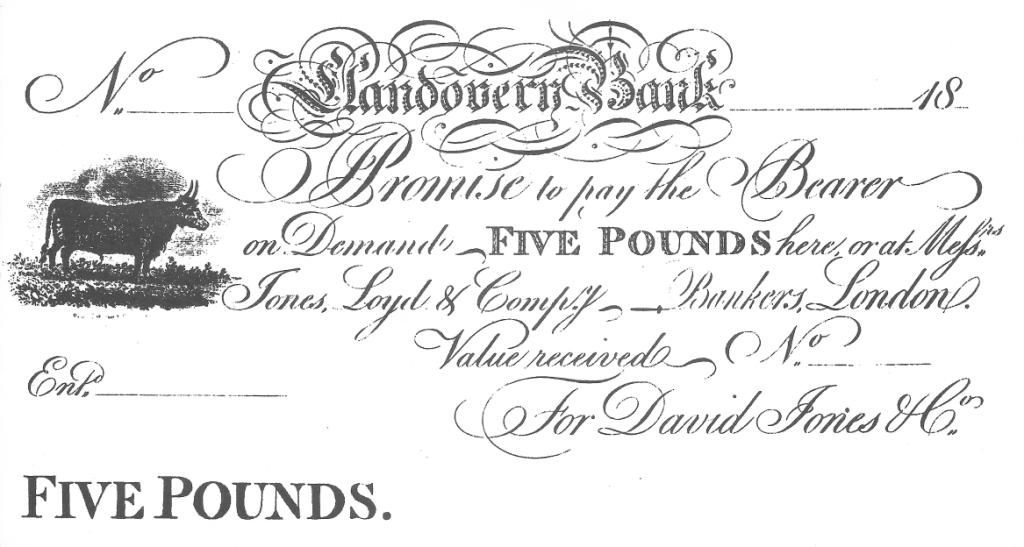
Anyone in charge of a drove had to carry at least £100 to pay for expenses on the way down to London and possibly £1,000s on the return journey. Highway men and muggers were a problem, until David Jones of Llandovery founded the Black Ox Bank in 1799.
Black Ox Bank £5 Promissory Note Jones had witnessed the landlord of the King's Head in Llandovery (where he worked as a young lad) keeping the dealers' money safe for them. Many years later Jones married an heiress who let him use £10,000 to set up a bank at that same inn. When the animals were sold in London, the dealer would give his gold to the Black Ox agent to bank for him. His credit would be waiting for him on his return to Llandovery. In 1909 the Black Ox Bank became part of Lloyds Bank.
Before the Black Ox Bank existed, dealers would often sew the money into their clothing for the return journey. Many innkeepers acted as informal bankers, the landlords being deemed trustworthy. Along established drover routes can be found inns by the name of "Lock and Key", indicating they would accept money for safe keeping, including one at Smithfield in London.
The main purpose of country roads used to be for moving beasts and for trade, so many of the roads we drive along today were made by and for drovers. Roads that have never been tarmacked have become byways or bridleways. Many have vanished altogether, but there is still a vast network of green lanes crisscrossing the British countryside.
So the next time you go for a country drive, picture the drovers walking with their animals to market.
Thelma Jeeves
COMMENTS FROM GROUP MEMBERS
Thank you very much. I found this very interesting.
My paternal Grandmother used to tell story about a Scottish cobbler who walked from Scotland to London and a female ancestor of mine who walked up to London from Aberystwyth with the Drovers. The two met there and together walked back to Aberystwyth with the Drovers. The Scot didn’t speak Welsh and the woman didn’t speak English, but they got married anyway; my Grandmother had many wonderful tales to tell about her cobbler Grandfather.
On my mother’s side, we had a Drover ancestor too and he made enough money to buy a big farm in the hills above Tregaron.
MQ
A friend gave us a book, sometime ago, on this very subject. Nevertheless, although we knew about the shoeing of cattle and the geese, we didn’t know about the pigs. The origin of place names was interesting too.
We also had a film crew here, a few years back, filming a series called “Drovers Gold”. It was strange finding actors and actresses walking about the yard, dressed in 17th Century costume and learning their lines, sitting outside the barn.
RM